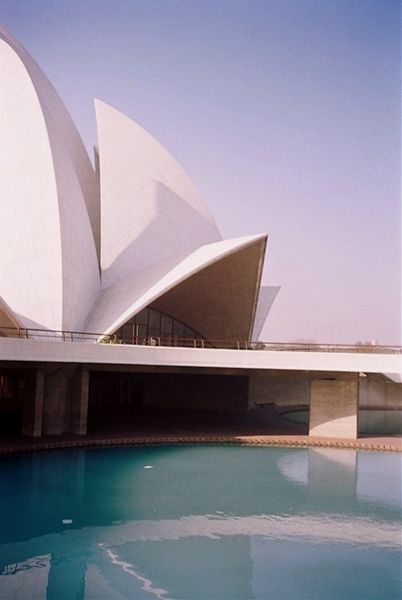
Lotus Temple
The Bahá'í House of Worship in Delhi, India, popularly known as the Lotus Temple due to its flowerlike shape, is a Bahá'í House of Worship and also a prominent attraction in Delhi. It was completed in 1986 and serves as the Mother Temple of the Indian subcontinent. It has won numerous architectural awards and been featured in hundreds of newspaper and magazine articles.
Track findings on anything interesting from Art and Design (architecture, fashion, fine-art, interior decoration, product design, and almost any form of aesthetics).
Saturday, November 6, 2010
Friday, October 22, 2010
Paper Sculpture
Jen Stark
Jen Stark is a contemporary artist whose famous work are impressively paper sculpted. She also works with drawing and animation. Her work draws inspiration from microscopic patterns in nature, wormholes, and sliced anatomy.
http://www.jenstark.com/index.php
Jen Stark is a contemporary artist whose famous work are impressively paper sculpted. She also works with drawing and animation. Her work draws inspiration from microscopic patterns in nature, wormholes, and sliced anatomy.
http://www.jenstark.com/index.php
Thursday, October 7, 2010
Movies (French)
4 beautifully filmed cinematic stories, all quinessentially French!
A moving story about love, life and the beauty of unexpected friendships.
Renée is the concierge of a grand Parisian apartment building, who meets with society’s expectations of what a concierge should be; reliable though totally uncultured. But beneath this façade lies the real Renée: passionate about culture and the arts, and more knowledgeable in many ways than her employers, with their outwardly successful but emotionally void lives.
This dark, slightly absurdist comedy is narrated by Nicolas, an eight-year-old boy supremely happy with his loving, doting parents and a colorful group of friends. It seems that life couldn't possibly improve - until Nicolas eavesdrops on his folks and surmises that his mother is pregnant. Horrified, he envisions a scenario where a new baby brother arrives and crowds him out of the house, leaving his parents with no time to care for him. Nicolas and his friends then cook up a series of wild schemes to dispose of the baby.
It is the second in a series of films produced by Musée d'Orsay, after The Flight of the Red Balloon. In the film, two brothers and a sister witness the disappearance of their childhood memories when they must relinquish the family belongings to ensure their deceased mother's succession.
It concerns Antoine, who must leave Lyon to help his mother who keeps the grocery in a village in southernFrance . His father, stricken with a heart attack, can no longer drive the truck that supplies the isolated hamlets. Antoine discovers the charm of these people, "bons vivants" (good living) ways and gradually comes to love his eccentric customers and finds the country of his childhood.
A moving story about love, life and the beauty of unexpected friendships.
Renée is the concierge of a grand Parisian apartment building, who meets with society’s expectations of what a concierge should be; reliable though totally uncultured. But beneath this façade lies the real Renée: passionate about culture and the arts, and more knowledgeable in many ways than her employers, with their outwardly successful but emotionally void lives.
This dark, slightly absurdist comedy is narrated by Nicolas, an eight-year-old boy supremely happy with his loving, doting parents and a colorful group of friends. It seems that life couldn't possibly improve - until Nicolas eavesdrops on his folks and surmises that his mother is pregnant. Horrified, he envisions a scenario where a new baby brother arrives and crowds him out of the house, leaving his parents with no time to care for him. Nicolas and his friends then cook up a series of wild schemes to dispose of the baby.
It is the second in a series of films produced by Musée d'Orsay, after The Flight of the Red Balloon. In the film, two brothers and a sister witness the disappearance of their childhood memories when they must relinquish the family belongings to ensure their deceased mother's succession.
It concerns Antoine, who must leave Lyon to help his mother who keeps the grocery in a village in southern
Tuesday, September 28, 2010
Fine Art (Sculpture)
Ron Muek
Ron Mueck is an Australian hyperrealist sculptor working in Great Britain. Mueck's early career was as a model maker and puppeteer for children's television. He moved on to establish his own company in London, making photo-realistic props and animatronics for the advertising industry. Although highly detailed, these props were usually designed to be photographed from one specific angle hiding the mess of construction seen from the other side. Mueck increasingly wanted to produce realistic sculptures which looked perfect from all angles.
Mueck concluded that photography pretty much destroys the physical “presence” of the original object, and so he turned to fine art and sculpture. In the early 1990s, still in his advertising days, Mueck was commissioned to make something highly realistic, and was wondering what material would do the trick.
Latex was the usual, but he wanted something harder, more precise. Luckily, he saw a little architectural decor on the wall of a boutique and inquired as to the nice, pink stuff’s nature. Fiberglass resin was the answer, and Mueck has made it his bronze and marble ever since.
Mueck's sculptures faithfully reproduce the minute detail of the human body, but play with scale to produce disconcertingly jarring visual images.
Ron Mueck is an Australian hyperrealist sculptor working in Great Britain. Mueck's early career was as a model maker and puppeteer for children's television. He moved on to establish his own company in London, making photo-realistic props and animatronics for the advertising industry. Although highly detailed, these props were usually designed to be photographed from one specific angle hiding the mess of construction seen from the other side. Mueck increasingly wanted to produce realistic sculptures which looked perfect from all angles.
Mueck concluded that photography pretty much destroys the physical “presence” of the original object, and so he turned to fine art and sculpture. In the early 1990s, still in his advertising days, Mueck was commissioned to make something highly realistic, and was wondering what material would do the trick.
Latex was the usual, but he wanted something harder, more precise. Luckily, he saw a little architectural decor on the wall of a boutique and inquired as to the nice, pink stuff’s nature. Fiberglass resin was the answer, and Mueck has made it his bronze and marble ever since.
Mueck's sculptures faithfully reproduce the minute detail of the human body, but play with scale to produce disconcertingly jarring visual images.
Saturday, September 25, 2010
Fashion (Pleated Pants)
Lacoste S/S 2011
Check out these cool pleated pants! Loosely cut and stylishly tapered with narrow hems. They really give a dandy and preppy feel as inspired from the 50s vintage pants.
Saturday, September 18, 2010
Design with Cardboard
House-ware & Furniture
Forming products and furniture in cardboard?
These life-size heavy-duty ‘paper sculpture’ could be far more functional and durable than you think ... …
Beside being a venerable workhorse of set designers in the theatre and movie business, cardboard furniture has also graced some of the world's nicest homes. Famous architect Frank O. Gehry is possibly the first to have introduced it to the design world – with his 1972 cardboard furniture collection "Easy Edges".
Nowadays, cardboard designed products and furniture are getting popular and in increasing demand!
Forming products and furniture in cardboard?
These life-size heavy-duty ‘paper sculpture’ could be far more functional and durable than you think ... …
Beside being a venerable workhorse of set designers in the theatre and movie business, cardboard furniture has also graced some of the world's nicest homes. Famous architect Frank O. Gehry is possibly the first to have introduced it to the design world – with his 1972 cardboard furniture collection "Easy Edges".
Nowadays, cardboard designed products and furniture are getting popular and in increasing demand!
Saturday, September 11, 2010
Jewellery Design
Philip Crangi
Acclaimed jewelry designer Philip Crangi has always drawn his inspiration from history; Greco-Roman artifacts, Baroque ironwork, and Japanese armor are but a few of the references found in his work. “I would describe my aesthetic as one of contrast in material, color and mood,” says Crangi, who was trained at the renowned Rhode Island School of Design as a goldsmith.
After graduating from RISD, Philip and his sister and business partner Courtney Crangi began creating unique objects and jewelry from their New York City studio. Using materials not often associated with traditional fine jewelry design, they created their signature collection, Philip Crangi, combining age-old techniques with a unique palette of gold, wrought iron and steel. Through this process, Philip Crangi crafts impeccably detailed heirloom pieces, which reflect the very personal style of the wearer, while at the same time creating classics for a new era.
Today, Philip Crangi is one of the most noted jewelry designers in the industry; in June, 2008 he was awarded the very prestigious CFDA Swarovski Award for Accessory Design and in 2007 he was named first runner-up for the CFDA/Vogue Fashion Fund Award.
http://www.gilesandbrother.com/
Acclaimed jewelry designer Philip Crangi has always drawn his inspiration from history; Greco-Roman artifacts, Baroque ironwork, and Japanese armor are but a few of the references found in his work. “I would describe my aesthetic as one of contrast in material, color and mood,” says Crangi, who was trained at the renowned Rhode Island School of Design as a goldsmith.
After graduating from RISD, Philip and his sister and business partner Courtney Crangi began creating unique objects and jewelry from their New York City studio. Using materials not often associated with traditional fine jewelry design, they created their signature collection, Philip Crangi, combining age-old techniques with a unique palette of gold, wrought iron and steel. Through this process, Philip Crangi crafts impeccably detailed heirloom pieces, which reflect the very personal style of the wearer, while at the same time creating classics for a new era.
Today, Philip Crangi is one of the most noted jewelry designers in the industry; in June, 2008 he was awarded the very prestigious CFDA Swarovski Award for Accessory Design and in 2007 he was named first runner-up for the CFDA/Vogue Fashion Fund Award.
http://www.gilesandbrother.com/
Subscribe to:
Posts (Atom)